Reward design
Everything on this page is measured, not asserted. The numbers come from
Flight4DEnv at its defaults — n_flights=5, n ~ U(2,4), max_steps=50,
hold_steps=5 — discounted at gamma=0.99 and averaged over 40 seeds.
Reproduce any of them with:
cd sessions/03-advanced/airtraffic
python scripts/calibrate_4d.py --seeds 40 \
    --agent noop --agent random --agent rule-based
The one-paragraph version
The reward is three direct per-step costs — predicted separation severity, 4D exit deviation, and a flat charge per clearance — plus a terminal mid-air charge sized by the steps the episode will now never fly. That is the whole thing. It is dominated by safety for every policy anyone has run on it, which is the intended ordering: safety is the objective that responds to control, and the other two exist to stop you buying it too cheaply.
The reward, in full
reward = -( w_safe * severity                              # safety
          + (w_safe / n_flights) * sum(deviation)          # timeliness
          + w_clearance * issued )                         # action
if terminated:
    reward -= collision_rate * w_safe * (max_steps - step_idx)
| Term | Form | Purpose |
|---|---|---|
| safety | w_safe x total predicted infringement severity |
The objective. Ranks first, carries the largest weight. |
| timeliness | w_safe / n_flights per aircraft, each deviation in [0, 1] |
The 4D exit gate. Closes the "solve it by wandering off" hole. |
| action | w_clearance, once, for any non-NOOP clearance |
Commands are not free. A transition cost — a property of the action, not the state. |
| mid-air | collision_rate x w_safe per remaining step, terminal |
Two co-level aircraft within 100 m. Scaled by steps unflown, so an early crash is not cheaper than a late one. |
There is no survival bonus and no terminal bonus of any kind. max_clearances
is a truncation condition and an observation feature, never a payout.
Severity is not a hand-made proximity function
severity = exp(-d_cpa / R) * exp(-d_alt / ALT_MIN_SEP), taken straight from the
simulator's own conflict definition, and pairs already at or beyond
ALT_MIN_SEP are not in the list at all.
The consequence is worth knowing before you touch anything: the vertical
credit falls out of the physics rather than being chosen. One flight level
removes 1 - exp(-0.5) = 39% of the severity; the second removes the remaining
61% by deleting the conflict outright. An earlier version used
(1 - d_alt / ALT_MIN_SEP), which paid a flat 50% for a first level that
resolves nothing — and the trained policy duly bought exactly that, on every
aircraft, at step 1, and stopped.
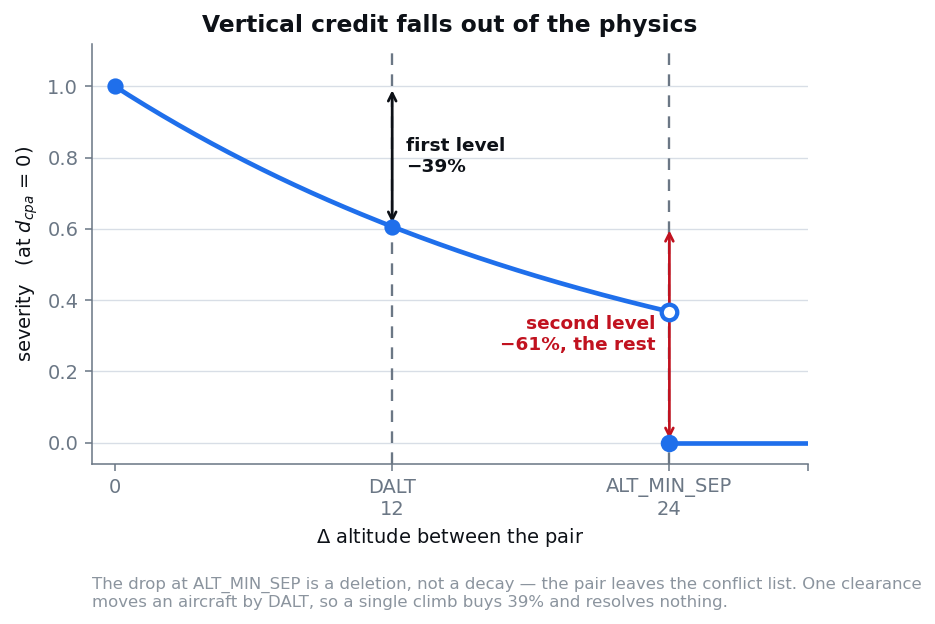
The drop at ALT_MIN_SEP is a deletion, not a decay — the pair leaves the
conflict list. That is why one clearance is never a fix.
Timeliness charges the projected endpoint, not the detour
This one is subtle and it is the fix for a real defect in the first-generation environment, where the timeliness term returned the deviation right now and was charged every step — so the reward integrated the whole detour. Over 100 seeds the reward penalised 9.963 while the KPI scored 0.039: the reward was saying never leave your plan while the ranking said leave it freely, but come back. Every policy duly learned not to deviate rather than to recover.
Flight4DEnv does not fix this by moving the charge to the horizon. It fixes it
by changing the quantity: _exit_deviation() returns where the aircraft will
cross, if it holds its current speed — a projection, not an instantaneous
displacement. A detour that is subsequently recovered projects back to its
target, so it costs nothing in the limit; only a deviation the aircraft cannot
recover from stays on the bill.
The two regimes, and why conflating them was a bug
Before an aircraft reaches the boundary its deviation is a projection.
After it has crossed, the deviation is a fact — the recorded crossing
time — and must stop moving. Clamping s_left at zero and projecting anyway
pinned the estimate to "now", so every aircraft that had already exited
drifted later and later, and an untouched, undisturbed aircraft accumulated
a phantom delay it had no way to cause. Pinned by
test_untouched_aircraft_have_zero_exit_deviation.
The scaling is the design statement
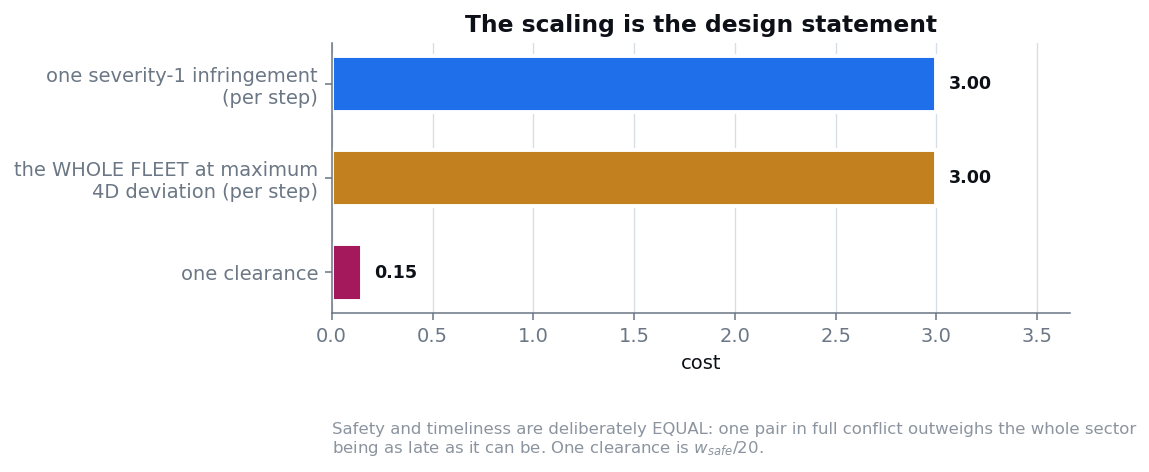
The absolute weights barely matter; the ratios are the argument:
| Quantity | Cost |
|---|---|
| one severity-1 infringement, per step | w_safe = 3.00 |
| the whole fleet at maximum 4D deviation, per step | 3.00 (equal, by design) |
| one clearance | w_clearance = 0.15 = w_safe / 20 |
So a single pair in full conflict outweighs every aircraft in the sector being as late and as far off-level as it is possible to be. That makes the priority explicit and checkable rather than a matter of taste.
Where the return actually comes from
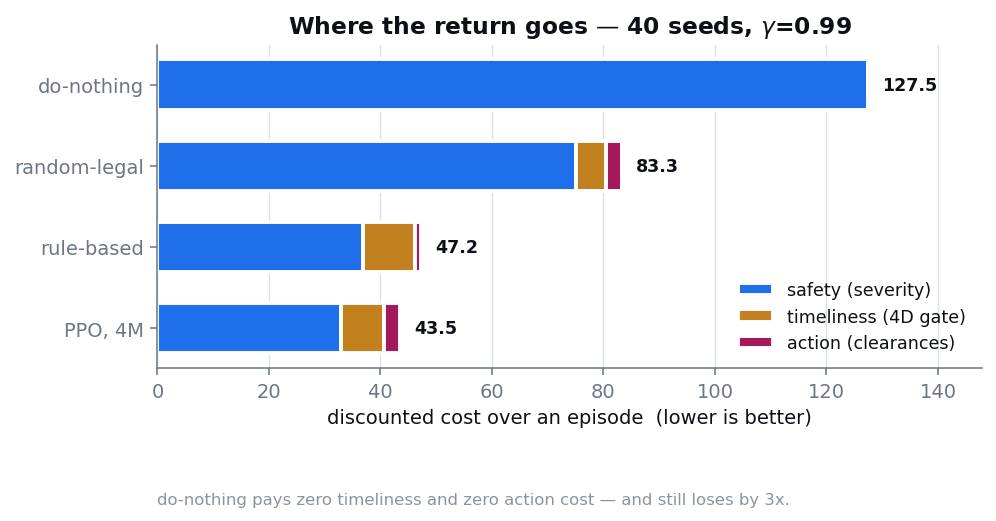
Discounted contribution of each term over a whole episode, 40 seeds. Costs are
shown positive — each is subtracted from the return, so smaller is better. The
mid-air charge is excluded; the failed column is where it lands.
| agent | safety | timeliness | action | total | failed | clearances | exit_miss |
|---|---|---|---|---|---|---|---|
| do-nothing | 127.51 | 0.00 | 0.00 | 127.51 | 40/40 | 0.0 | 0.000 |
| random-legal | 74.99 | 5.51 | 2.84 | 83.34 | 22/40 | 22.7 | 0.590 |
| rule-based | 36.80 | 9.35 | 1.11 | 47.25 | 7/40 | 7.9 | 0.595 |
| PPO, 4M curriculum | 32.83 | 7.81 | 2.88 | 43.52 | 3/40 | 22.3 | 0.164 |
These are seeds 0-39
calibrate_4d.py measures on the low seed block. score_4d.py ranks on the
held-out block from 900000, where do-nothing fails 96 of 100 rather than 40
of 40. Both are consistent; do not compare a number from one against a
number from the other.
Four things fall out of this table.
The brick is the worst policy on the board, by a factor of nearly three. It is perfectly on time and perfectly efficient — its timeliness and action bills are exactly zero, by construction — and it still loses, because it dies in every episode and severity accumulates until it does. This is the single most useful row here: it demonstrates that two of the three objectives can be maxed by doing nothing at all, so any claim to have "optimised the reward" has to say which term.
Safety dominates every policy's bill: 90% of random's total, 78% of the controller's, 75% of PPO's. That is deliberate. It is the term that responds to control, and the ranking puts separation first.
The controller buys safety with lateness. It pays more timeliness than
random (9.35 against 5.51) for less than half the safety cost, and its
exit_miss (0.595) is no better than random's (0.590). That is not a defect —
it is the RECOVERY_SEP_FACTOR trade, made deliberately and documented on the
controller page. It is also exactly the headroom a
learned policy is supposed to take.
PPO wins both objectives and pays for it in clearances: better safety and
3.6x better exit_miss than the controller, for 2.8x the aircraft-commands
(22.3 against 7.9). Whether that is a good trade is the leaderboard's question,
not the reward's.
Why these are direct costs and not potentials
This is the design decision most worth understanding before you change anything.
The reward could have been written as potential-based shaping,
F(s,s') = gamma * phi(s') - phi(s), which
Ng, Harada & Russell (1999)
proved leaves the optimal policy unchanged. It is not.
The reason is that the usual motivation for shaping does not apply here.
Predicted severity is already dense: a conflict twenty steps out is in
today's sum, because _severity() sums over predict_conflicts(horizon) rather
than over conflicts happening right now. There is no sparse-reward problem to
solve, so there is nothing for shaping to buy.
What it would cost is clarity. A direct cost says what we actually mean — this state is bad, by this much, now — and the weights above are then a readable statement of priority.
The price of that choice, stated plainly
A direct cost can move the optimum. Potential-based shaping provably
cannot. So the weights on this page are not merely a statement about how
fast the problem is learned; they are part of what "solved" means. If you
retune w_safe or w_clearance, you are changing the answer, not just the
search — and you should re-check the ranking, not just the return.
Adding shaping yourself
Shaping is not used, but it is a legitimate thing to add — it is Track C of the design sprint. If you do, this is what the environment already knows about it.
Two potentials fit the problem naturally:
- separation —
phi = -(summed pairwise proximity over co-altitude traffic) - timeliness —
psi = -(exit deviation)
Because they cannot move the optimum, the shaping scale is the safest parameter in the reward to turn up. Measured on the first clearance out of a do-nothing policy, on the retired first-generation environment:
| shaping scale | mean Δ return | fraction that help | 90th pct |
|---|---|---|---|
| 5 | −0.953 | 9.5% | −0.11 |
| 15 | −0.806 | 21.8% | +0.98 |
| 30 | −0.633 | 26.1% | +2.19 |
| 60 | −0.285 | 30.9% | +5.01 |
The mean stays negative throughout, and it should — a randomly chosen clearance is a bad idea. What changes is the top decile: at the lowest setting even the best 10% of clearances were neutral-to-negative, so there was nothing for the gradient to climb.
Both factors of the potential must be smooth
A potential that merely asks "are these two within ALT_MIN_SEP?" is a
step function in altitude. ALT_MIN_SEP is 24 and one clearance moves
an aircraft by DALT = 12, so the first FL_INC takes a pair from 0 to 12
— still inside the threshold, still counted, shaping reward exactly
zero. The agent only gets paid on the second climb, which is precisely
the step it had no reason to reach.
Both constants are unchanged in Flight4DEnv, so this trap is still live.
Three results that survive the environment they were measured on
These come from a 276k-injection probe on the retired first-generation environment. The arguments are algebraic or structural and carry over; the numbers are historical.
Scale cannot create gradient where a term is exactly zero. Raising the congestion weight until one event outweighs the worst timeliness bill moved the help rate from 3.0% to 3.0% and doubled the variance. Most single clearances change no congestion event at all in the step they are issued.
Decomposing a scalar reward per aircraft is a no-op.
Σᵢ ½ Σ_{pairs ∋ i} c = Σ_pairs c — same scalar, same gradient. It buys
something only if you stop re-adding (per-head advantages in a custom loss) or
change the functional form. The max-per-aircraft form measured worse than
the pairwise sum, because max discards every improvement except to an
aircraft's single worst conflict.
Signal and reachability are different problems. A dense potential lifted the help rate from 3% to 21% by saying something useful on the ~90% of injections where the KPI did not move at all. The two-level macro lifted every reward variant, because it made a resolving move reachable in one clearance instead of two. The potential supplies signal; the macro supplies reachability. Neither substitutes for the other — and note that the macro's usefulness here is about the outbound half only; see why the controller does not use it.
The mid-air charge has to beat the cost of flying on
Every term is a cost, so ending the episode early stops the meter. If the terminal charge is smaller than the cost of continuing, the optimal policy is to crash immediately.
calibrate_4d.py checks this on every run:
mid-air charge at step 0                  450.00
... per remaining step                      9.00
WORST cost of flying on, over all states  170.55
The mean is not the test. The distribution is skewed and the agent only has to find one state where dying is cheaper, so the check is against the worst case over all visited states — currently 450 against 170.55, a comfortable margin. Re-run it after any weight change.
Why the reward is not the whole story
Two failures on this environment look like reward problems and are not.
The episode can end before most of the conflicts do. A fresh near-uniform
policy exhausts its clearance budget long before the horizon, experiences a
fraction of the conflicts, and never reaches the states where the interesting
decisions live. Shaping changes the value of states you visit; it can do nothing
about states you never reach. See
--noop-bias.
A zeroed term is an unconstrained dimension. Annealing the clearance cost to exactly zero makes the return indifferent to how many clearances are issued — and an entropy bonus will expand into any dimension the return does not push back on. Measured: entropy 4.43 → 9.34 nats, episode length 50 → 31.9, straight back into the truncation failure. If you want that curriculum, anneal from a small floor rather than from zero.
Related
- Environment API — the exact terms and constants.
- The rule-based controller — what the measured baseline row above is actually doing.
- The Flight Challenge — what you are ranked on, which is not the return.
- Training — flags, and the flat-curve checklist.