Priority4DController — how the bar is set
This is the agent every submission is measured against. It is a couple of hundred lines of ordinary Python, it sees exactly the observation a neural policy sees, and it exists so that "my agent beats do-nothing and a random legal policy" is not the strongest claim anyone can make. That is a very low bar — a random legal policy crashes out of a third of its episodes.
This page documents what the controller does and why each decision is there. For
how to run it, see the litmus test. For the
environment it operates on, see the
Flight4DEnv API reference.
Where it lives
sessions/03-advanced/airtraffic/agents/rule_based_4d.py —
Priority4DController, plus Noop4DController (the brick) and the decode()
helper. Both are re-exported from agents.
| Argument | Meaning |
|---|---|
n_flights, max_steps, hold_steps |
must match the environment — see the warning below |
severity_gate |
ignore predicted conflicts weaker than this |
It exposes SB3's predict(obs, deterministic=...), so the same scoring loop runs
it, a PPO checkpoint and a competition submission interchangeably.
It has to be told the sector's shape
None of n_flights, max_steps or hold_steps is recoverable from the
observation. Its length pins down n_flights only once you already know
N_FEATS, and the horizon is needed to invert t_conflict. Get them wrong
and every quantity the controller computes is off by a constant factor,
silently, because the geometry still looks plausible. The competition
harness passes the frozen scenario in explicitly for exactly this reason.
What it is allowed to know
Nothing privileged. No peeking at the simulator, no conflict list handed to it from the side. It receives the same flat observation vector as a neural policy and inverts the normalisation itself:
d = decode(obs, n_flights, max_steps, hold_steps)
# -> level, severity, hold_left, t_conflict, d_alt, step, x, y  (physical units)
The environment squashes two of these through tanh and one through
t/(t + horizon). decode() inverts all three exactly rather than approximating
them — a controller that guesses at its own inputs is not a baseline, it is a
second source of error. t_conflict gets particular care: q == 1 means no
conflict predicted, which is a genuine infinity rather than a very large number,
and is inverted explicitly instead of dividing by an epsilon and hoping.
The legality mask comes from the observation too:
Every action the controller proposes is checked against it, so it issues no invalid clearances by construction.
Why it does not use the two-level macro
This is the most interesting thing on the page, and it is worth reading before you design your own action set.
First, what the macro actually is
Flight4DEnv gives you two ways to change altitude, and the difference is the
whole argument:
| Clearance | What it does | Cost |
|---|---|---|
FL_INC / FL_DEC |
move one level, and stay there until told otherwise | 1 clearance |
FL_INC2_T / FL_DEC2_T |
move two levels, then automatically revert after hold_steps |
1 clearance — the revert is free |
The _T means temporary. That auto-revert is deliberate and it is not
charged: _advance_holds() treats it as "the second half of an instruction
already issued and already paid for."
Why it looks like a free lunch
Three reasons, and all three are true:
- One level is not a fix.
DALTis 12 against anALT_MIN_SEPof 24, so a singleFL_INCleaves the pair still in conflict. Two levels is the minimum effective vertical intervention — the environment's own module docstring says exactly that. - It is a third of the price. By hand the same manoeuvre is
FL_INC+FL_INC+RESUME= three clearances. The macro is one. Clearances are both a reward term and a hard episode-ending budget. - It serves the 4D objective for free. Coming home is otherwise a separate decision you have to remember to take; the macro bakes it in.
So it looks strictly dominant. It is not, and the reason is worth more than the result.
Why it loses anyway
The return time is fixed the moment you issue it, and can never be renegotiated.
The revert fires inside env.step(), before the next observation. The
aircraft is already back at its original level by the time the controller can
see anything or act. You committed, at issue time, to a return time you had no
way of knowing was right.
And here it is systematically wrong. All the converging traffic enters
co-level, heading for one hotspot — that is sustained proximity, and it
outlasts hold_steps. The macro is built for a transient encounter: something
passes, you step aside, you come back. In this geometry, "come back on a timer"
means "come back into the traffic."
Measured, it is worse than a random legal policy: 20 failures in 40 episodes against random's 34 in 100 — 50% against 34%. The diagnosis over those 20:
| Failure mode | Count |
|---|---|
| displaced, reverted, hit | 12 |
| never commanded at all | 8 |
| hit while still displaced | 0 |
Read those three rows together. Zero failures happened while an aircraft was displaced, so the macro's outbound half works perfectly — the return leg is the entire problem. And the 8 that were never commanded are the budget in action: only one aircraft may be commanded per step, so clearances spent on macros that will need re-issuing are clearances some other aircraft never gets.
Nor can you fix it by aiming better. Sweeping the just-in-time lead — how many steps before the predicted conflict the macro is issued, so its hold window straddles closest approach — from 1 to 6 steps never got below 50% failures. That is what rules out "you just used it wrong."
The general lesson
An auto-reverting macro bundles two decisions — go and come home — into one instruction, and prices them as one clearance. That is a bargain when the right return time is knowable at issue time, and a trap when it depends on how the episode develops.
So this controller uses permanent level changes for lasting separation and
an explicit RESUME once the aircraft is genuinely clear. It pays three
clearances instead of one to keep the when in its own hands. The recovery
gate is the whole point.
This is not an argument against the macro
A learned policy that can predict the right return time from the geometry can use it well — and it is the cheapest resolving action in the game. The argument is only that a fixed-timer heuristic cannot decide when adaptively. If your agent can, the macro is yours to exploit.
The strategy
1. Assign slots, once, at reset
All converging traffic enters co-level. With ALT_MIN_SEP two levels wide,
the conflict-free slots are base, ±2, ±4 (and ±6 if the band allows). Earliest
predicted arrival keeps its level — it "has priority" — and later arrivals move
progressively further.
Converging traffic is identified by having a predicted conflict at all:
background flights already cross at other levels and never appear in the list.
That makes the controller indifferent to n, which varies per episode and is not
in the observation.
The bug worth knowing about: clipping collapses slots
The obvious implementation — base[i] + offset[k], clipped into the band —
is wrong near a rail. Clipping collapses +2 and +4 onto the same level and
quietly assigns two aircraft the same slot. Measured, that was 8 of 10
remaining failures, every one of them a pair sitting exactly where it had
been told to sit.
The fix is to build the slot list once, from the shared entry level, keeping only offsets that actually fit, and hand out distinct entries.
2. Steer, one level per step
The environment commands at most one aircraft per step, so the controller picks
the most urgent — soonest predicted conflict first — and moves it one level
toward its slot with FL_INC / FL_DEC. If that action is masked, it tries the
next aircraft.
3. Come home when genuinely clear
Once an off-plan aircraft is at least RECOVERY_SEP_FACTOR hotspot radii from
every other converging flight, a single RESUME restores its level and speed.
Distance from the other flights, not from the hotspot: they all share an entry level, so it is separation from them that decides whether coming home is safe. Keying on the hotspot over-waits the pairs that diverge quickly.
The slot is then retired — otherwise _steer sees a gap the instant the aircraft
is home and flies it straight back out, the controller undoing its own recovery
one clearance at a time. d_alt gives the deviation, so the entry level is
recoverable from the observation without remembering it.
When several aircraft are clear at once, only one RESUME can go out this
step — so something has to break the tie. It is assignment order, not flight
index: the same earliest-t_conflict-first ordering computed once at reset,
stored, and re-used here. Flight index carries no information about the
problem; the priority the controller already committed to does.
RECOVERY_SEP_FACTOR is the tuning knob
It is a straight safety-against-timeliness trade, and the docstring in
rule_based_4d.py carries the measured sweep over 40 seeds.
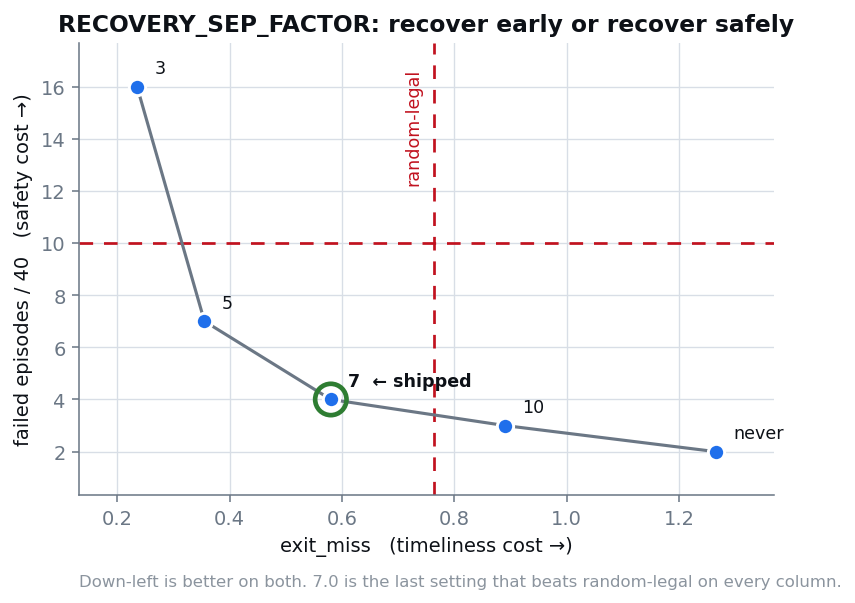
Read it down-and-left: both axes are costs, so the frontier bends away from the
origin and every setting buys one column by spending another. The dashed lines
are random-legal. 7.0 is the last point that sits inside both of them —
push further out and exit_miss crosses to the wrong side, which is the moment
the 4D objective stops being served at all. recovering early
buys a better exit_miss and costs failures; recovering late (or never) buys
safety and parks aircraft off-level. The shipped value, 7.0, is the last row of
that sweep that beats a random legal policy on every column — an exit_miss
worse than random's would mean the 4D objective is no longer being served at all.
This is the trade your agent has to win
A learned policy is not restricted to one global recovery radius. It can decide per aircraft, using the conflict geometry it can see, and it can use the speed pulse — which the controller ignores entirely. That is where the headroom is.
Noop4DController
Do nothing, ever. The floor every other number is read against, and a genuinely useful one here: the brick is perfectly on time and perfectly efficient, and still loses badly on safety.
What it deliberately does not do
Four open weaknesses, each a straightforward improvement and each a reasonable place to start an agent design:
- It never issues a speed clearance. The entire velocity axis — and with it the schedule-neutral pulse — is unused.
- One global recovery radius for every aircraft in every geometry.
- Slots are assigned once, at reset, and never re-planned as the episode develops.
- It ignores the clearance budget. It does not ration, and it does not know how much of the episode is left.
tests/test_rule_based_4d.py defines what any controller must keep true — valid
actions only, and a real improvement over doing nothing.
Related
- Run the litmus test — the commands, and what the columns mean.
Flight4DEnvAPI reference — the observation it decodes and the mask it obeys.- The Flight Challenge — how the same KPIs become a ranking.